AI is no longer just something for the future. It is already part of our daily life.
You can see it in tools that write content, create images, answer questions, and even help businesses run faster. Tasks that used to take hours can now be done in minutes.
Because of this, the way people work is changing. Some old skills are not as useful as before. At the same time, new AI skills are becoming more important. People who learn these skills are getting better jobs and more ways to earn money.
But many people feel stuck. They don’t know what to learn or where to begin. So they wait.
And that’s where the real problem starts.
If you wait too long, others will move ahead. But if you start now, even with small steps, you can stay ahead.
The good news is this. You don’t need to be a programmer or a tech expert. You just need to learn simple, useful AI skills that people are already paying for. If you want more simple guides like this, you can explore our AI learning resources.
In this guide, you will learn which AI skills matter, how to learn them step by step, and how you can use them to earn in the future.
Why AI Skills Matter More Than Ever
AI is already part of daily life.
You may not notice it, but you use AI almost every day. When you search on Google, watch videos, shop online, or use chat tools, AI is working in the background. It helps suggest what to watch, what to buy, and even what to write.
Businesses are actively hiring people who understand AI.
Companies want people who can use AI tools to save time and get better results. You don’t need to be a tech expert. Even basic knowledge of AI tools can help you get hired or win clients.
Many jobs are evolving, not just disappearing.
It’s true that some tasks are being replaced by AI. But most jobs are not going away. They are changing. For example, writers now use AI to write faster. Marketers use AI to plan campaigns. So the job stays, but the way you do it becomes smarter.
AI skills can increase your income and career options.
When you know how to use AI, you can do more work in less time. This means you can take more projects, earn more money, and explore new career paths. It also gives you an advantage over others who don’t use AI.
Top AI Skills You Should Learn in 2026 and Beyond

If you want to benefit from AI, you don’t need to learn everything. You just need to focus on a few useful skills that people are already paying for.
Let’s look at the most important ones.
1. AI Tool Mastery
This means learning to use AI tools effectively. Tools like ChatGPT, Claude, and Gemini can help you write content, solve problems, and even assist with coding.
Many people use these tools, but only a few know how to use them properly to save time and get better results.
Once you understand how these tools work, you can complete tasks faster and with less effort. This is the easiest skill to start with and gives quick results.
2. Prompt Engineering
Prompt engineering is all about how you give instructions to AI. The quality of your results depends on how clearly you ask your questions. If your input is simple or unclear, the output will be weak as well.
But when you learn to give clear, detailed prompts, the results improve significantly. This skill may look small, but it can make a big difference in how effectively you use AI tools.
3. AI Automation
AI automation helps you reduce manual work by setting up systems that run autonomously. Tools like Zapier, Make, and n8n allow you to connect different apps and automate tasks.
For example, you can set up automated emails, manage leads, or handle repetitive tasks without having to do them again and again. Businesses value this skill because it saves time and increases productivity.
4. Data Basics
Learning data basics means understanding how to handle and read simple data. You don’t need advanced knowledge or complex math. Basic skills like using Excel or Google Sheets are enough to get started.
This helps you organize information, track results, and understand patterns. It is a useful skill that supports many other AI-related tasks.
5. AI Content Creation
AI content creation is one of the most in-demand skills today. With the help of AI, you can create blog posts, ads, social media content, scripts, and even visuals.
Businesses need content regularly, and AI makes the process faster and easier. This skill is especially useful for freelancers and agencies because it directly connects to earning opportunities.
6. No-Code / Low-Code AI Building
This skill allows you to build apps and tools without writing code. Platforms like Bubble and Glide make it possible to create simple systems using AI.
You can build tools for businesses, create your own projects, or offer services to clients. It may take a little more time to learn, but it has strong long-term value and earning potential.
Best Ways to Start Learning AI (Step-by-Step)
Starting AI can feel confusing at first. But if you follow a simple step-by-step path, it becomes much easier. You don’t need to learn everything at once. Just take one step at a time and stay consistent.
Step 1: Pick One Skill Only
The biggest mistake beginners make is trying to learn too many things at once. This usually leads to confusion and slow progress. Instead, choose one skill and give it your full attention.
For example, you can start with:
- AI content creation
- AI tools like ChatGPT
- Basic automation
When you focus on one area, you learn faster and start seeing results sooner.
Step 2: Use Free Resources First
You don’t need to spend money in the beginning. There is a lot of free content online that can help you learn the basics.
Some good starting points include:
- YouTube tutorials
- Free online courses
- Blog guides and walkthroughs
At this stage, your goal is simple. Understand how things work and get comfortable using AI tools.
Step 3: Learn by Doing
This is the most important step. Just watching videos or reading guides is not enough. You need to actually use AI and practice.
You can start with small tasks like:
- Writing a short blog post
- Creating social media content
- Testing different prompts
The more you practice, the faster you improve. Learning by doing helps you gain real skills, not just knowledge.
Step 4: Build a Portfolio
As you start practicing, don’t ignore your work. Save it and organize it. This becomes your portfolio.
Your portfolio can include:
- Sample blog posts
- AI-generated content
- Simple automation examples
Even small projects matter. They show what you can do and help you stand out when applying for jobs or clients.
Step 5: Start Earning Early
You don’t need to wait until you become an expert. Once you have basic skills, you can start earning.
You can begin with:
- Freelancing platforms
- Offering small services
- Helping small businesses
Real work teaches you much faster than practice alone. You also build confidence and improve your skills with each project.
Common Mistakes to Avoid
When starting with AI, many people slow themselves down by making a few simple mistakes. These mistakes are very common, especially for beginners, but they can easily be avoided if you stay aware of them.
One big mistake is trying to learn everything at once. AI is a wide field, and jumping from one skill to another can quickly become overwhelming. Instead of making progress, you end up confused and stuck. It’s always better to focus on one skill at a time and build a strong base.
Another common issue is watching tutorials without taking action. It may feel like you are learning, but without practice, nothing really sticks. Real learning happens when you actually use the tools, test things yourself, and apply what you learn.
Some people also ignore real-world skills. They spend too much time on theory and not enough on practical use. But AI becomes valuable only when you can solve real problems, such as creating content, helping a business, or saving time through automation.
Finally, many people wait too long to start. They keep thinking they need more knowledge before taking action. This delay can hold you back while others move forward. The truth is, you learn faster when you start early and improve along the way.
Read Also: Stop Believing These Common AI Myths
How to Make Money with AI Skills
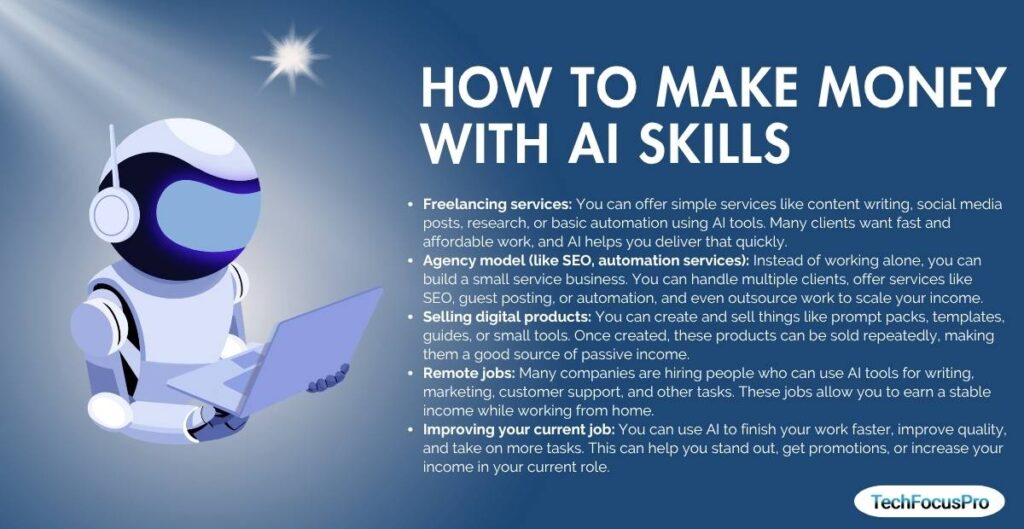
Once you learn AI skills, the next step is to turn them into income. The good thing is that there are multiple ways to earn, and you can choose what works best for you.
- Freelancing services: You can offer simple services like content writing, social media posts, research, or basic automation using AI tools. Many clients want fast and affordable work, and AI helps you deliver that quickly.
- Agency model (like guest posting, automation services): Instead of working alone, you can build a small service business. You can handle multiple clients, offer services like SEO, guest posting, or automation, and even outsource work to scale your income.
- Selling digital products: You can create and sell things like prompt packs, templates, guides, or small tools. Once created, these products can be sold repeatedly, making them a good source of passive income.
- Remote jobs: Many companies are hiring people who can use AI tools for writing, marketing, customer support, and other tasks. These jobs allow you to earn a stable income while working from home.
- Improving your current job: You can use AI to finish your work faster, improve quality, and take on more tasks. This can help you stand out, get promotions, or increase your income in your current role.
How Long Does It Take to Learn AI Skills?
The time it takes to learn AI skills depends on what you choose and how much you practice. Some skills are easy to learn in a few weeks, while others take a bit more time.
The table below gives you a clear idea of how long each skill takes, along with its difficulty and earning potential. This will help you choose the right starting point based on your goals.
| AI Skill | What You Do (Simple) | Time to Learn | Difficulty |
|---|---|---|---|
| AI Tools | Use tools like ChatGPT for writing, research, and tasks | 1–2 weeks | Easy |
| Prompt Writing | Write clear instructions to get better AI results | 2–3 weeks | Easy |
| Content Creation | Create blogs, ads, and social posts using AI | 2–4 weeks | Easy |
| AI for SEO | Use AI to optimize content and improve rankings | 3–5 weeks | Easy–Medium |
| Automation | Set up systems to handle repeated tasks | 1–2 months | Medium |
| Data Basics | Organize and understand simple data | 1–2 months | Medium |
| No-Code Building | Build simple apps or tools without coding | 1–3 months | Medium |
What This Means for You
As you can see, not all AI skills take the same time to learn. Some skills, like AI tools and content creation, can help you start earning in just a few weeks. On the other hand, skills like automation or no-code development take more time but offer higher long-term income.
If your goal is quick results, start with easier skills. If you are thinking long-term, it’s worth learning skills that take more time but have better earning potential.
The key is simple. Stay consistent, practice daily, and focus on one skill at a time. That’s how you move from learning to earning.
Future Trends You Should Watch
AI is growing fast, and things are changing every year. If you understand where things are going, you can prepare early and stay ahead of others.
One big trend is the rise of AI and automation jobs. More businesses are using AI to save time and reduce manual work. Because of this, they need people who can set up systems and manage these tools.
Another important shift is the growing demand for non-technical AI users. You don’t need to be a programmer anymore. Writers, marketers, business owners, and freelancers are all using AI in their daily work. This means more opportunities for people with simple, practical skills.
We are also seeing AI becoming part of almost every industry. From healthcare to education, from marketing to customer support, AI is being used everywhere. This makes it a valuable skill no matter what field you are in.
The biggest takeaway is this. People who adapt early will have a strong advantage. Those who start learning now will find it easier to grow, earn, and stay relevant in the future.
FAQs
Can I learn AI skills without coding?
Yes, you can. Many AI tools today are made for beginners. You can learn skills like content creation, prompt writing, and automation without writing code. This makes it easier for anyone to start.
Which AI skill is best for beginners?
The best starting point is AI tool usage and content creation. These are easy to learn and can help you start earning quickly. Once you feel comfortable, you can move to advanced skills like automation.
How long does it take to start earning with AI?
It depends on your effort and consistency. Some people start earning in a few weeks by learning basic skills like writing or simple tasks. Others may take a few months if they choose more advanced skills.
Do I need expensive courses to learn AI?
No, you don’t. There are many free resources available online. You can learn from YouTube, blogs, and free courses. Paid courses can help later, but they are not required to get started.
What is the easiest way to make money with AI?
The easiest way is freelancing. You can offer services like writing, social media content, or simple automation. These services are in demand and easy to start with basic skills.
Are AI jobs really in demand?
Yes, demand is growing fast. Many companies are looking for people who can use AI tools to improve their work. This demand is expected to increase in the coming years.
Can AI replace my job?
AI may change how your job works, but it won’t replace everyone. People who learn AI can actually improve their work and stay valuable. It’s better to adapt than ignore it.
What should I learn first in AI?
Start with one simple skill like using ChatGPT or creating content with AI. Learn how it works, practice daily, and then slowly move to more advanced skills.
Is AI a good career choice for the future?
Yes, it is. AI is becoming part of every industry. Learning AI skills can open many career paths and help you earn more in the long run.
Final Thoughts
AI is changing the way people work, learn, and earn. It’s no longer something optional. It is becoming a basic skill, just like using the internet or a smartphone.
The good news is that you don’t need to learn everything or become an expert. You just need to start with one skill and keep improving step by step. Small actions, done daily, can lead to big results over time.
What matters most is taking action. Many people keep waiting, but those who start early move ahead.
In simple words, the future belongs to those who are ready to learn and adapt. If you start now, you give yourself a strong advantage.