Key Takeaways
- Cross-platform development eliminates the need for multiple codebases — build once, deploy everywhere across iOS, Android, web, and desktop.
- Garage2Global delivers proven results — 40% faster time-to-market and 50% cost reduction compared to native app development.
- Modern frameworks like Flutter and React Native provide native-quality performance and user experience without the expense of building separate apps.
- End-to-end service from discovery to post-launch support ensures clients have a dedicated partner throughout the entire app lifecycle.
Deep expertise in cross-platform development with years of hands-on experience building successful apps across multiple industries
Are you spending double the budget and time building separate iOS and Android apps?
Most startups face this exact problem. Two codebases mean two teams, double the bugs, and twice the maintenance headaches. It’s expensive and slow.
Cross-platform app development by Garage2Global fixes this. We build your app once and deploy it everywhere: iOS, Android, web, and desktop. One codebase. One team. Way less money.
The results? Apps launch 40% faster and cost 50% less than native development. And they don’t feel cheap or clunky. Modern frameworks like Flutter and React Native deliver smooth, native-quality experiences.
In this guide, you’ll learn how cross-platform app development by Garage2Global actually works, which frameworks we use, and why startups choose Garage2Global to build apps that scale.
Let’s get into it.
What Is Cross-Platform App Development?
Definition and Core Concept
Cross-platform development means you write your app code once, and it runs on multiple devices. iOS? Check. Android? Check. Web browsers? Yep. Even a desktop if you need it.
Think of it like this: instead of building the same house twice with different blueprints, you build it once, and it works everywhere. That’s the “build once, deploy everywhere” philosophy.
The old way? You’d write your app in Swift for iPhones, then rebuild the entire thing in Kotlin for Android. Same features, same design, totally different code. It works, but it’s slow and costs a fortune.
Cross-platform flips this on its head. One codebase. Multiple platforms. Way smarter.
How Cross-Platform Development Works
Here’s what actually happens under the hood.
You write your business logic, design your screens, and build your features in one language. The framework (like Flutter or React Native) takes that code and translates it into native components for each platform.
So when someone taps a button on their iPhone, it triggers native iOS code. The same button on Android triggers native Android code. The user can’t tell the difference — it feels completely native.
Platform-specific stuff? That gets handled separately. Need iPhone Face ID or Android’s back button? No problem. The framework integrates those native modules smoothly.
The magic number: you typically reuse 70-90% of your code across all platforms. The remaining 10-30% is where you customize platform-specific features or tweak the UI to match Apple’s or Google’s design rules.
Why Choose Cross-Platform App Development by Garage2Global?
Garage2Global’s Unique Value Proposition
We’ve been building cross-platform apps for startups long enough to know what works and what doesn’t. Not every app needs this approach, but for most growing businesses, it’s a no-brainer.
Garage2Global specializes in helping startups move fast without burning through their budget. We’re not here to drag timelines or build apps that look good in demos but crash in real life. We build apps that launch quickly, work smoothly, and actually scale.
Our focus? Flutter and React Native. These aren’t just buzzwords — they’re proven frameworks that deliver real results. We’ve used them to build everything from fitness trackers to e-commerce platforms, and we know how to get the most out of them.
Key Benefits of Garage2Global’s Approach
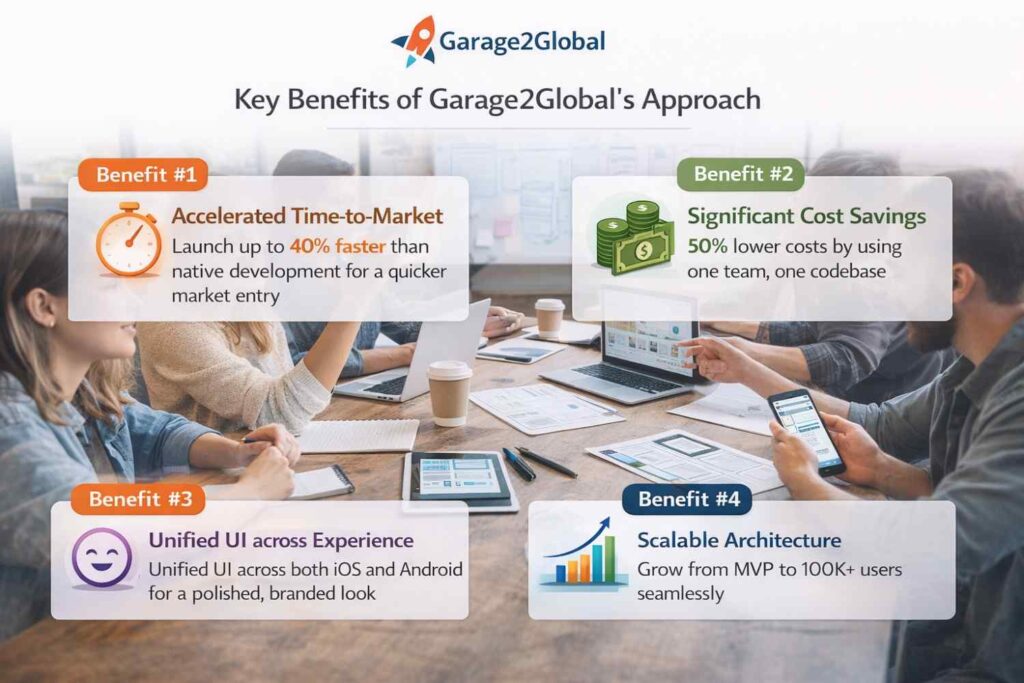
Benefit #1: Accelerated Time-to-Market
Time matters. A lot. We’ve seen competitors beat better products simply because they launched first.
With cross-platform development, you’re not waiting for two teams to finish two separate builds. One codebase means faster development, quicker testing, and launching on iOS and Android simultaneously.
The numbers? We deliver apps about 40% faster than native development. That fitness app we built? Four months from kickoff to the App Store. A native build would’ve taken six or seven months.
Hot reload is a game-changer here. Developers make a change, and it shows up instantly on the test device. No rebuilding, no waiting. This speeds up everything from fixing bugs to testing new features.
Benefit #2: Significant Cost Savings
Let’s talk about money. Building two native apps means paying for two teams, two QA processes, and two separate maintenance cycles. Costs add up fast.
Cross-platform development typically costs 50% less than building separate native apps. You’re paying one team, managing one codebase, and fixing bugs once instead of twice.
That retail client we worked with? Their budget would’ve covered a decent iOS app OR a basic Android app. Instead, they got both platforms plus a web version for the same price.
Benefit #3: Consistent User Experience
When your app looks different on iOS versus Android, users notice. It’s confusing and makes your brand feel less polished.
Cross-platform development maintains a unified design system. Same buttons, same flows, same animations. A user switching between their iPhone and Android tablet gets the exact same experience.
But we’re not lazy about it. iOS users still get their swipe gestures and bottom navigation. Android users get material design and floating buttons. We customize where it matters.
Benefit #4: Scalable Architecture
Most apps start as MVPs — just enough features to test the market. But if things go well, you need to scale fast.
The beauty of cross-platform? It’s built to grow. Add a new feature, and it rolls out everywhere at once. Optimize performance, and every user benefits.
We’ve taken clients from 1,000 users to 100,000+ without rebuilding the app. The foundation is solid from day one.
Popular Cross-Platform Frameworks Used by Garage2Global
Choosing the right framework can make or break an app project. The wrong choice leads to performance issues, expensive rewrites, and frustrated developers.
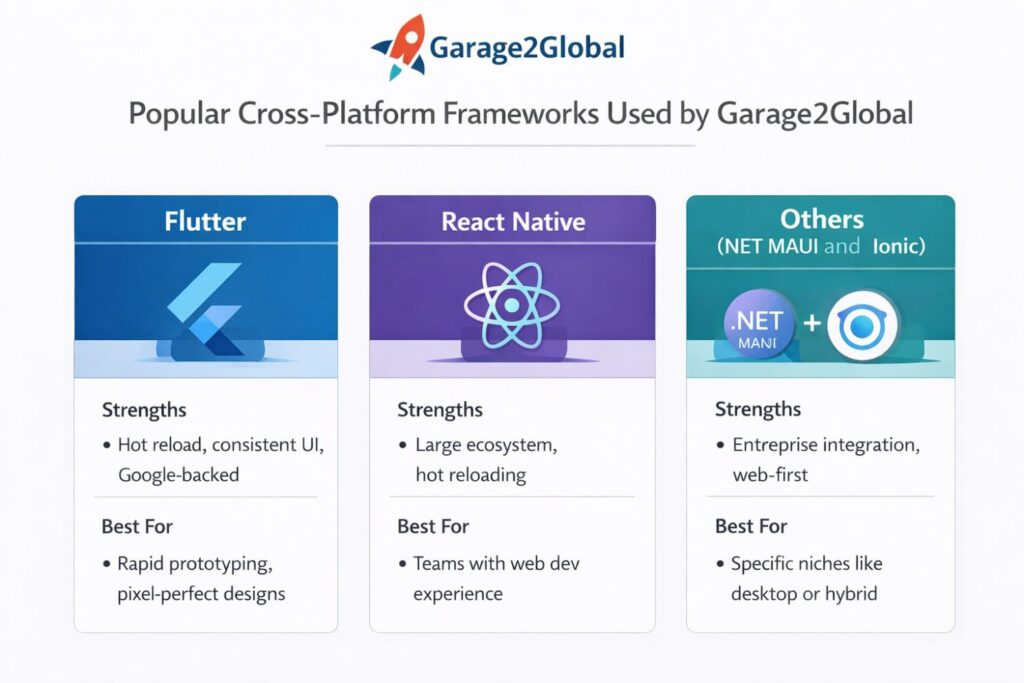
Garage2Global has worked with nearly every cross-platform framework out there. Their team knows the strengths and weaknesses of each one. But for most projects, they stick with two proven winners: Flutter and React Native.
These frameworks aren’t just trendy — they deliver real results. Fast development, solid performance, and apps that users actually enjoy using.
Let’s dive into what makes each framework special and when Garage2Global uses them.
Flutter Development by Garage2Global
What is Flutter?
Flutter is Google’s cross-platform framework. It uses a programming language called Dart, which isn’t as well-known as JavaScript but gets the job done efficiently.
The big advantage? Write code once, and it runs everywhere. iPhones, Android phones, web browsers, and even desktop computers. All from a single codebase.
Key Strengths:
Hot reload is one of Flutter’s best features. Developers make a code change and see it appear on their test device instantly. No waiting for the app to rebuild. This single feature can cut development time by weeks.
Performance is impressive. Flutter compiles directly to native code, so apps run smoothly and fast. Users get a responsive experience with no lag or stuttering.
Pixel-perfect UI control sets Flutter apart from competitors. Instead of using platform-specific components, Flutter draws everything itself. This means an app looks identical on a brand-new iPhone and a three-year-old Android phone. Designers love this consistency.
The widget library is extensive. Need buttons? Forms? Animations? Charts? Flutter has pre-built components for almost everything. And when something custom is needed, building it is straightforward.
The community keeps growing. More developers, more tutorials, more third-party packages. Finding solutions to problems gets easier every month.
Best Use Cases:
Garage2Global reaches for Flutter when clients need rapid prototyping or MVP development. Speed matters when testing a new business idea.
Apps requiring custom, pixel-perfect designs are perfect for Flutter. If the design team has a unique vision, Flutter can execute it without compromise.
High-performance applications run well on Flutter. Smooth scrolling, quick animations, responsive interactions — Flutter delivers.
Startups needing quick market entry benefit from Flutter’s speed. Launch faster, test ideas sooner, iterate quickly based on user feedback.
Garage2Global’s Flutter Expertise:
The team at Garage2Global has been building Flutter apps for years. They know the framework’s quirks, shortcuts, and performance optimization techniques.
Their portfolio includes fitness apps, healthcare platforms, and fintech solutions — all built with Flutter. Each project taught them new ways to push the framework’s capabilities.
When clients need offline functionality, complex animations, or custom UI components, Garage2Global’s Flutter expertise shines through.
React Native Development by Garage2Global
What is React Native?
React Native comes from Meta (formerly Facebook). It’s built on React, the massively popular web framework used by companies like Netflix, Airbnb, and Instagram.
The foundation is JavaScript and React. If a development team already knows these technologies, jumping to React Native is easy.
Key Strengths:
Leveraging existing web development skills is huge. Companies don’t need to hire specialized mobile developers — their web team can build mobile apps.
The third-party library ecosystem is massive. Need payment processing? There’s a library. Want social login? There’s a library. Maps, analytics, push notifications — all available with simple integrations.
Hot reloading works just like Flutter’s hot reload. Make changes, see them instantly. Development stays fast and productive.
Community support is unmatched. React Native has one of the largest developer communities in mobile development. Getting help or finding solutions is easy.
Native module integration is smooth. When platform-specific features are needed, React Native makes adding them straightforward. The framework doesn’t fight against native capabilities.
Best Use Cases:
Teams with JavaScript or React experience are natural fits for React Native. The learning curve is minimal, and developers can be productive quickly.
Apps requiring extensive third-party integrations work great. The library ecosystem means most features can be added without custom development.
Social media platforms, content-heavy applications, and news apps run well on React Native. Meta uses it for Facebook and Instagram, so it handles these use cases excellently.
Projects with existing React web apps can share code between platforms. This code reuse speeds up development and keeps features consistent.
Garage2Global’s React Native Capabilities:
Garage2Global employs expert JavaScript developers who understand React Native deeply. They’ve built e-commerce platforms, booking systems, and social apps using the framework.
Custom module development is part of their expertise. When a needed feature doesn’t exist in the library ecosystem, their team builds it from scratch.
Performance optimization is a specialty. They know how to keep React Native apps running smoothly, even with complex features and large user bases.
That retail platform mentioned earlier? Built with React Native. The client had an existing React web app, so Garage2Global shared components between web and mobile, cutting development time significantly.
Other Frameworks in Garage2Global’s Toolkit
While Flutter and React Native handle most projects, Garage2Global occasionally uses other frameworks for specific situations:
| Framework | Primary Use | Key Advantage | Ideal For |
| .NET MAUI | Enterprise applications | Deep Microsoft ecosystem integration | Corporate clients using Windows infrastructure |
| Ionic | Hybrid applications | Web-first development approach | Progressive web apps (PWAs) and simple mobile apps |
| Xamarin | Legacy system support | C# programming language | Companies heavily invested in Microsoft technologies |
- Alt text: “Cross-platform framework comparison Flutter React Native by Garage2Global.”
We don’t use these often, but when a client has specific enterprise needs or existing Microsoft infrastructure, they can be the right choice.
Garage2Global’s Cross-Platform Development Process
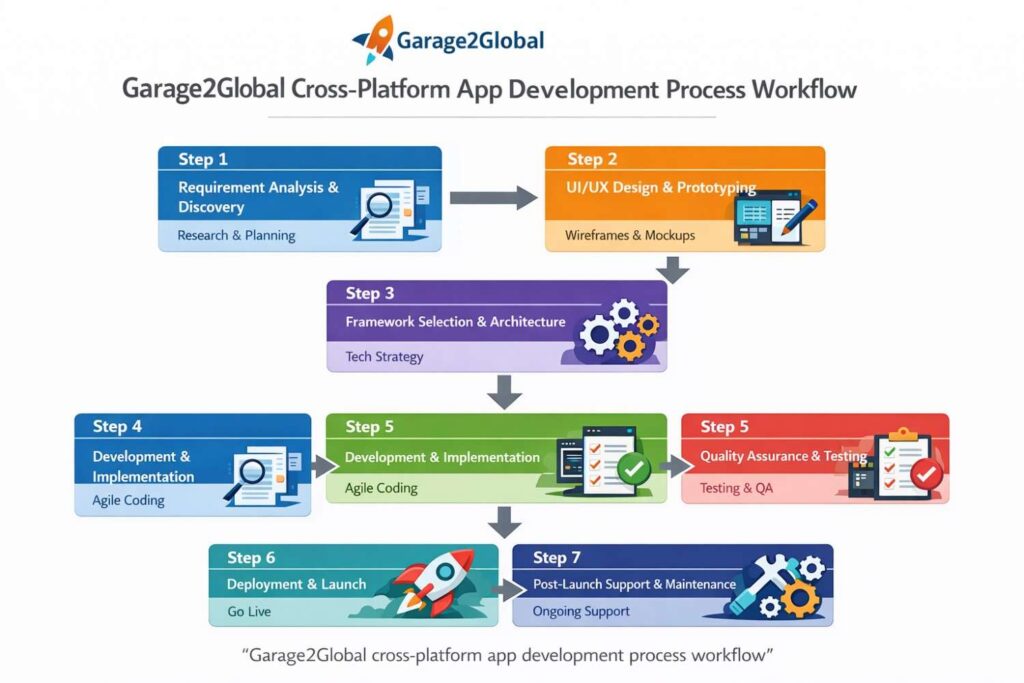
Garage2Global has refined its development process over dozens of projects. It’s not complicated, but it’s systematic. Every step has a purpose, and nothing gets skipped.
Their approach is end-to-end, meaning they handle everything from the initial idea to post-launch support. Clients don’t need to juggle multiple vendors or fill in gaps themselves.
The methodology is client-centric. Regular check-ins, transparent communication, and flexibility when priorities shift. Agile development practices keep projects moving forward in two-week sprints, with working features delivered consistently.
Here’s how Garage2Global takes an app from concept to the App Store.
Step 1 – Requirement Analysis & Discovery
- Stakeholder interviews to hear directly from decision-makers and end users
- Business goal alignment with technical capabilities
- Technical feasibility assessment to confirm the idea can actually be built
- Platform prioritization — iOS first, Android first, or both simultaneously
- Timeline and budget planning with realistic estimates
- Documentation creation so everyone knows exactly what’s being built.
Step 2 – UI/UX Design & Prototyping
- User research and persona creation to understand the target audience
- Wireframing with basic layouts showing where everything goes
- High-fidelity mockups adding colors, fonts, and branding.
- Interactive prototypes letting clients click through before coding starts.
- Design system creation, ensuring consistency across every screen.
- Platform-specific design considerations for native iOS and Android patterns
- Client feedback loops to catch issues early when they’re easy to fix
Step 3 – Framework Selection & Architecture
- Framework recommendation based on requirements, budget, and team skills
- Technical architecture design supporting current features and future growth
- Shared business logic planning to maximize code reuse (70-90%)
- Platform-specific customization strategy for the remaining 10-30%
- Third-party integration planning for payments, analytics, and other services
- Scalability considerations to handle growth from 100 to 100,000+ users
Step 4 – Development & Implementation
- Agile sprint methodology with two-week cycles delivering working features
- Code reusability focus achieving 70-90% shared code across platforms.
- Platform-specific UI customization, ensuring a native feel on each device.
- API integration connecting to backend services and databases
- Offline functionality implementation for features that work without internet
- Real-time collaboration with clients through demos and progress updates
Step 5 – Quality Assurance & Testing
- Automated testing to catch bugs before human testers see them
- Real device testing on actual iPhones and Android phones (old and new)
- Performance optimization, ensuring smooth operation on older devices
- Security testing to find vulnerabilities before hackers do
- User acceptance testing (UAT) with real users providing feedback
- Bug fixing and refinement are happening continuously throughout development.
Step 6 – Deployment & Launch
- App store submission to Apple App Store and Google Play Store
- Web deployment if the project includes a web version
- Server setup and configuration were done properly from the start.
- Launch strategy support, helping clients plan their go-to-market
- Marketing asset preparation, including screenshots and promotional videos
Step 7 – Post-Launch Support & Maintenance
- Performance monitoring catches issues in real-time.
- Bug fixes and updates are delivered quickly when problems arise.
- Feature enhancements based on user feedback and analytics
- OS update compatibility, ensuring the app works with new iOS and Android versions.
- Analytics integration tracking how users actually use the app
- Ongoing optimization keeping the app fast, secure, and reliable as it grows
Industries Garage2Global Serves
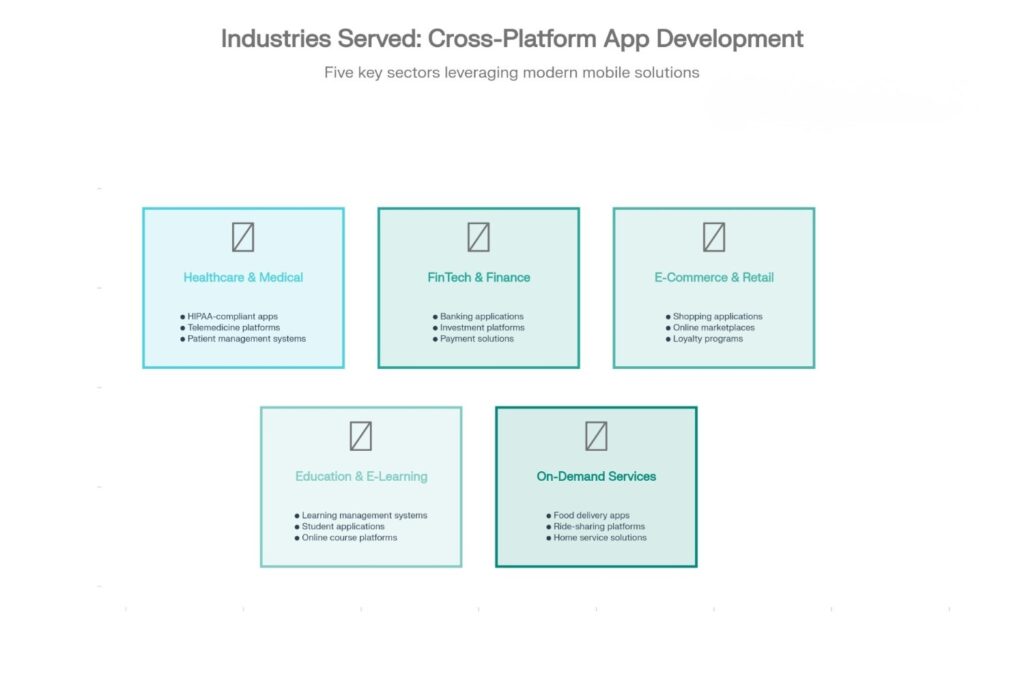
Garage2Global builds apps across multiple industries. Their cross-platform expertise adapts to different business needs and regulatory requirements.
Healthcare & Medical:
- HIPAA-compliant applications protecting patient privacy and medical data
- Telemedicine platforms connect doctors and patients remotely.
- Patient management systems track appointments, prescriptions, and health records.
FinTech & Finance:
- Banking applications for checking balances, transfers, and account management
- Investment platforms help users buy stocks, track portfolios, and manage wealth.
- Payment solutions process transactions securely and quickly
E-Commerce & Retail:
- Shopping apps with product browsing, cart, and checkout features
- Marketplace platforms connecting buyers and sellers
- Loyalty programs reward repeat customers with points and perks.
Education & E-Learning:
- Learning management systems deliver courses and track student progress.
- Student engagement apps with quizzes, discussions, and interactive content
- Online course platforms are making education accessible anywhere.
On-Demand Services:
- Food delivery apps connecting restaurants, drivers, and hungry customers
- Ride-sharing platforms match drivers with passengers.
- Home services apps for booking cleaners, plumbers, and handymen
Each industry has unique challenges. Garage2Global’s experience means they understand what works and what doesn’t in each sector.
How to Get Started with Cross-Platform Development by Garage2Global?
The Consultation Process
Step 1: Initial Discovery Call
Getting started is simple. The first step is a discovery call where Garage2Global learns about the app idea and what the business is trying to achieve. They discuss technical requirements, ask questions, and figure out if cross-platform development is the right fit. This consultation is completely free with no obligation to move forward.
Step 2: Proposal & Estimation
After understanding the project, Garage2Global creates a detailed proposal. This includes the complete project scope, a framework recommendation (usually Flutter or React Native), and a timeline with clear milestones. Pricing is transparent from the start. No vague estimates or surprise costs later.
Step 3: Kickoff & Development
Once everyone agrees on the plan, the project kicks off. Garage2Global allocates a dedicated team, plans the first sprint, and sets up regular communication channels. Development happens iteratively, with working features delivered every two weeks. Clients see progress constantly, not just at the end.
Why Startups Trust Garage2Global
Expertise
Garage2Global specializes in cross-platform development. Their team has years of hands-on experience with Flutter and React Native, not just theoretical knowledge. The proven portfolio speaks for itself with successful apps across healthcare, retail, finance, and more.
Efficiency
Speed matters for startups. Garage2Global uses agile methodology to deliver fast iterations and quick market entry. While competitors are still planning, their clients are already testing with real users.
Affordability
Startup budgets are tight. Garage2Global offers startup-friendly pricing with cost-effective solutions that don’t sacrifice quality. Flexible engagement models mean clients can choose fixed-price contracts or time-and-material arrangements based on what works best for them.
Support
The relationship doesn’t end at launch. Garage2Global provides true end-to-end service, including post-launch maintenance, bug fixes, and feature updates. Dedicated account management means there’s always someone who knows the project inside and out. They approach every project as a long-term partnership, not a one-time transaction.
Investment & Pricing Transparency
Cross-platform apps built by Garage2Global typically cost 30-50% less than developing separate native apps. The exact price depends on complexity and features, but the savings are substantial.
Pricing is based on what the app actually needs, not inflated estimates. Clients can choose fixed-price contracts for predictable budgets or time-and-material billing for projects where requirements might evolve.
Most importantly, there are no hidden costs. The proposal shows everything upfront, so clients know exactly what they’re paying for.
Frequently Asked Questions
How much does cross-platform app development cost with Garage2Global?
Cross-platform app development with Garage2Global costs $10,000-$25,000 for basic MVPs, $30,000-$60,000 for mid-tier apps, and $75,000+ for enterprise projects, with 30-50% savings vs. native.
How long does it take to develop a cross-platform app?
On average, 40% faster than native. Simple apps: 2-3 months, Medium complexity: 4-6 months, Complex apps: 6-12 months. Timeline depends on features and scope.
Will my cross-platform app perform as well as a native app?
Yes, modern frameworks like Flutter and React Native deliver near-native performance. Garage2Global optimizes for speed, ensuring smooth user experiences.
Can I add platform-specific features to my cross-platform app?
Absolutely. Garage2Global implements platform-specific functionality using native modules while maintaining shared business logic.
Which framework should I choose: Flutter or React Native?
Depends on your needs. Flutter excels in custom UI and performance. React Native is ideal for teams with JavaScript expertise. Garage2Global recommends based on your specific requirements.
Can existing native apps be converted to cross-platform?
Yes, Garage2Global can migrate native apps to cross-platform frameworks, though it often involves rebuilding with the existing logic and design.
How does Garage2Global ensure app quality?
Through rigorous testing on real devices, automated testing, code reviews, performance optimization, and UAT before launch.
What post-launch support does Garage2Global provide?
Ongoing maintenance, bug fixes, OS updates, feature enhancements, performance monitoring, and technical support.
Can cross-platform apps be published on app stores?
Yes, apps built with Flutter or React Native can be published on Apple App Store, Google Play, and web platforms.
Does Garage2Global sign NDAs?
Yes, Garage2Global respects confidentiality and signs NDAs to protect your app idea and business information.
Conclusion
Cross-platform app development has changed the game for startups and growing businesses. Garage2Global has proven this approach works. Their track record shows apps launching 40% faster and costing 50% less than traditional native development.
What sets Garage2Global apart is its end-to-end service model. From the initial discovery call through post-launch support, clients have a dedicated partner who understands their business and technology.
Ready to transform your app idea into reality?
Schedule a free consultation with Garage2Global today. Discuss the project, get honest feedback, and see if cross-platform development is the right fit.